
13 min read
It's the middle of June, which can only mean one thing! It's that time of year again! Not only the time of year where I'm most active on social media 🙈, but it also means that Pixel Pioneers is back for another conference, and this one was a corker!
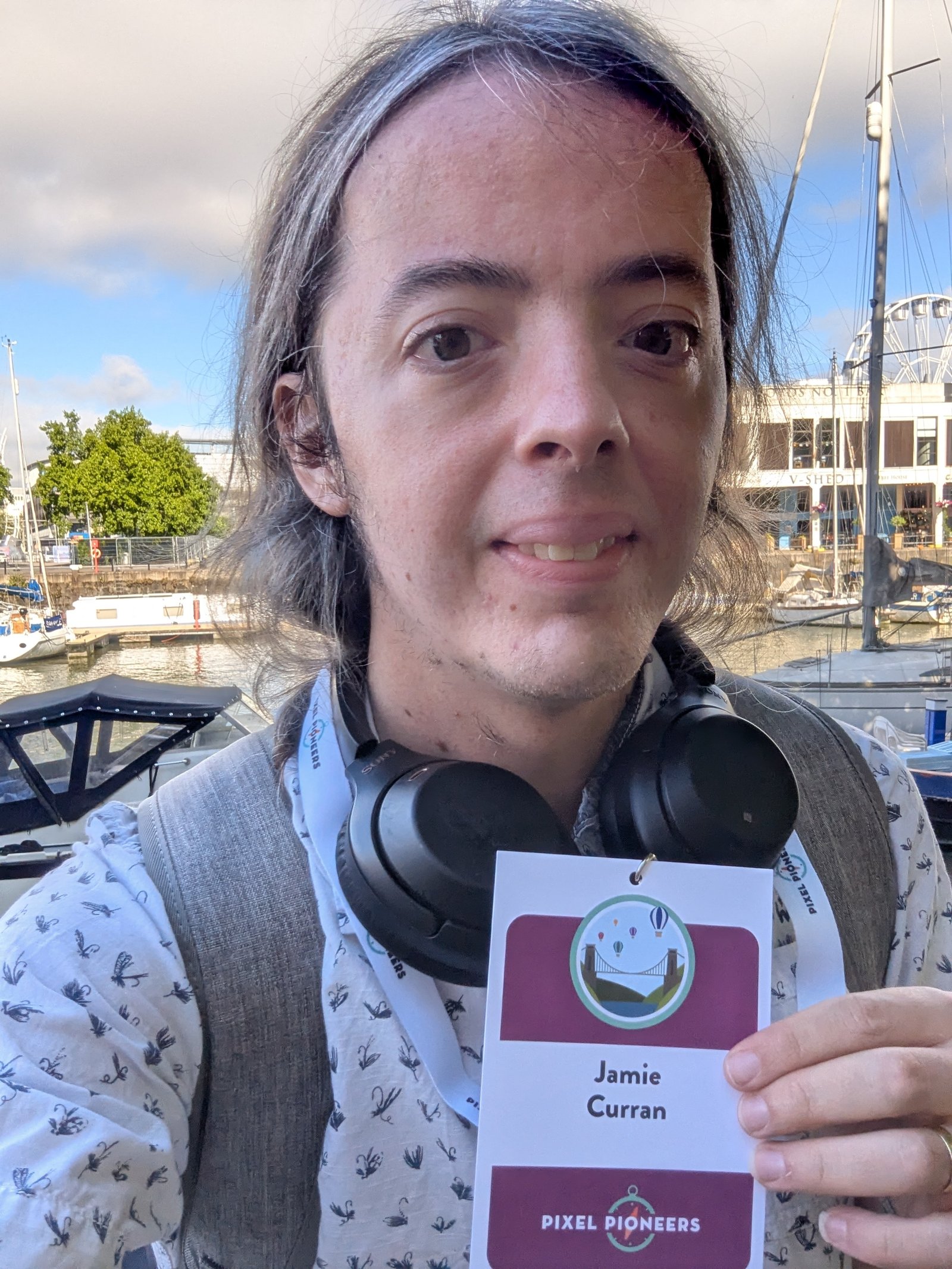
Flying Solo
Though this isn't the first time I've been to Pixel Pioneers on my own (last year I was the only person from my company who went), it is however, the first time I've attended as an entirely free agent. After what could be described as a tumultuous 6 months professionally, having time to reconnect with the community, network a little, and have some much-needed time to myself turned out to be just what the doctor ordered. It also meant I was able to explore Bristol more this time, and end each of my two days clocking in a minimum of 13,000 steps!
Settling In
The Thursday before the official beginning of the conference has always been one of my favourite parts of attending Pixel Pioneers. The early train ride, watching the rolling hills of the countryside zoom by with an audiobook and the click-clack of my knitting needles as I worked on The Garment as my soundtrack made for a pretty idyllic morning.
When the train pulled into Bristol Temple Meads, I took a leisurely stroll to my AirBnB, dropped off my heavy bags, unpacked, and headed right back out to try out The Climbing Hangar which had still been under construction the last time I was here, so getting to (figuratively) chip my teeth on it with plenty of time until the evening's festivities was lovely.
Appetising Beginnings
A spot of lunch and an establishment of my base of operations later, it was time for the Warmup event at Just Eat HQ. Being a solo operator at events like these can be intimidating, but the moment I walked in, it felt like I was meant to be there - the lovely Geri Reid came up to greet me and make me feel welcome (event after I made a slight fool of myself by saying how cool it was that we all got to gather at the JustEat HQ without realising that she was herself a JustEat employee 🙈.
Thereafter, I got chatting to Molly Nye (who gave an excellent lightning talk on the effective use and planning of Design Systems), Josh King, and their "Supreme Overlord" (their words!) whose name escapes me about everything from Wedding Quests and Swords to Midlandic nights out.
Let's get this party started
After a bit of time to warm up and chat with folk, it was time for the main event of the night - Lightning Talks! This started a bit of a theme that would carry forward into the rest of the conference with 2 of the 3 talks at the warm-ups covering the topic of Design Systems, from Molly (as previously alluded to) and my fellow Jamie covering the topic from the perspective of a designer and developer respectively. There was also a talk by the brilliant Marwa Gorvan on the topic of Designing with Aphantasia, which was a fascinating look into how one can still thrive as a designer despite the lack of access to a "Mind's Eye".
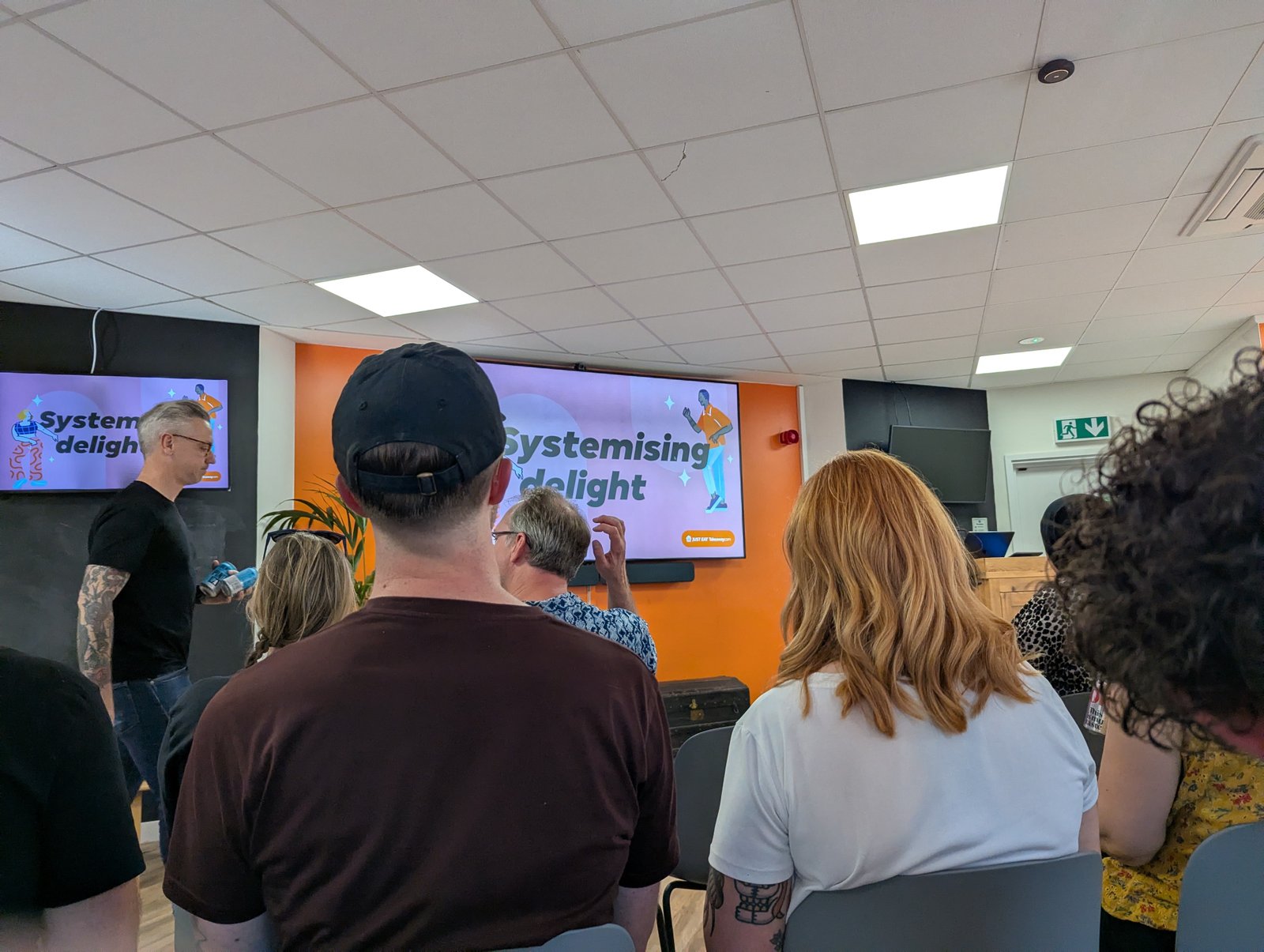
After the talks, we all excitedly flocked to the dining table to indulge in and bond over some delicious pizza courtesy of Just Eat and Pizza Express. It was here that I met the people who would become my fellow musketeers and partners-in-crime throughout the conference: Duncan and Ellie who had also flown solo to attend the conference. (Thank you both so much for hanging out and keeping me company for the duration of the conference! 🩵).
The Browsers, The Bots, and the Beeps and Boops
Before we knew it, it was conference day! I was quite fortunate, in that my AirBnB was conveniently located on the other side of the venue, so I was able to almost literally roll out of bed and collect my pass in the morning! There, I was met once again by Geri, followed by Luke Murphy (one of the speakers, who carried on the theme of Design Systems!) and his freshly inducted colleague Harriet from Zeroheight, one of the sponsors of the conference, Molly, and some of the other JustEat crew, as well as new friendo Duncan! When it was time, Mother Hen Geri herded us inside, we met up with Ellie, and got settled in for some brainfood!
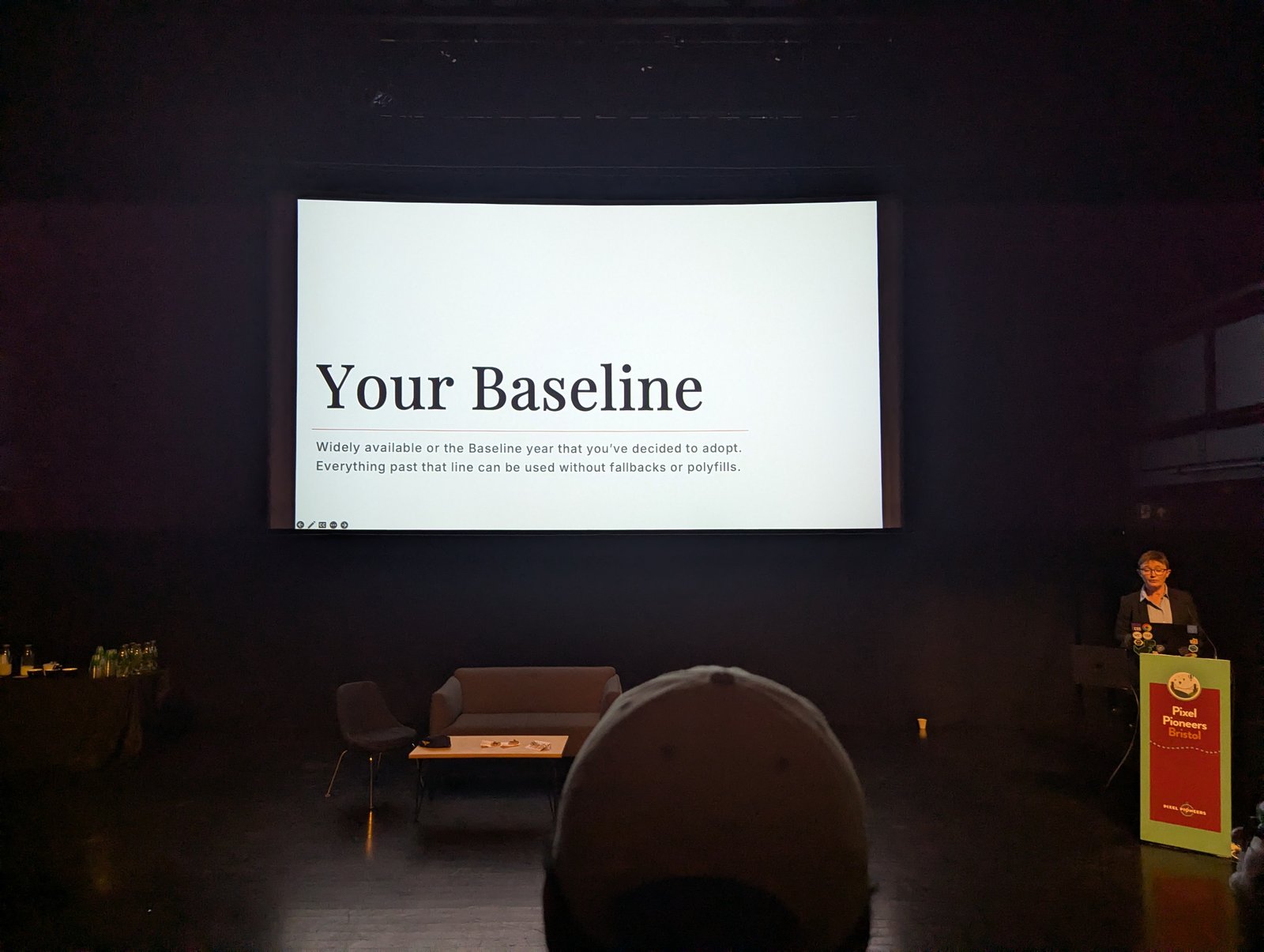
A Pragmatic Guide to Browser Support - By Rachel Andrew
The conference kicked off with a look at clarifying when the new and exciting bits of (mainly) CSS become widely available and supported by most modern browsers. It was super interesting not only due to its nature as a behind-the-curtain look at how new features get gradually added to browsers, and how that's signposted to developers, but also a possibly unintentional cautionary tale of getting too sucked in to the Hype Train when a new feature is announced, and assessing where that feature is at before deciding to widely adopt it.
For example, container queries, which have been in the general CSS zeitgeist for the last couple of years, has recently become widely supported by the majority of browsers. When that example was used, I felt as though it rather highlighted the position we often find ourselves in as developers. While we do our utmost to drive down loading / waiting times for users as much as possible, we hold a (largely) patient vigil as we wait for features we're all champing at the bit to use to become widely available.
Dev x Design x PM: A Trio in Transition - By Morgane Peng
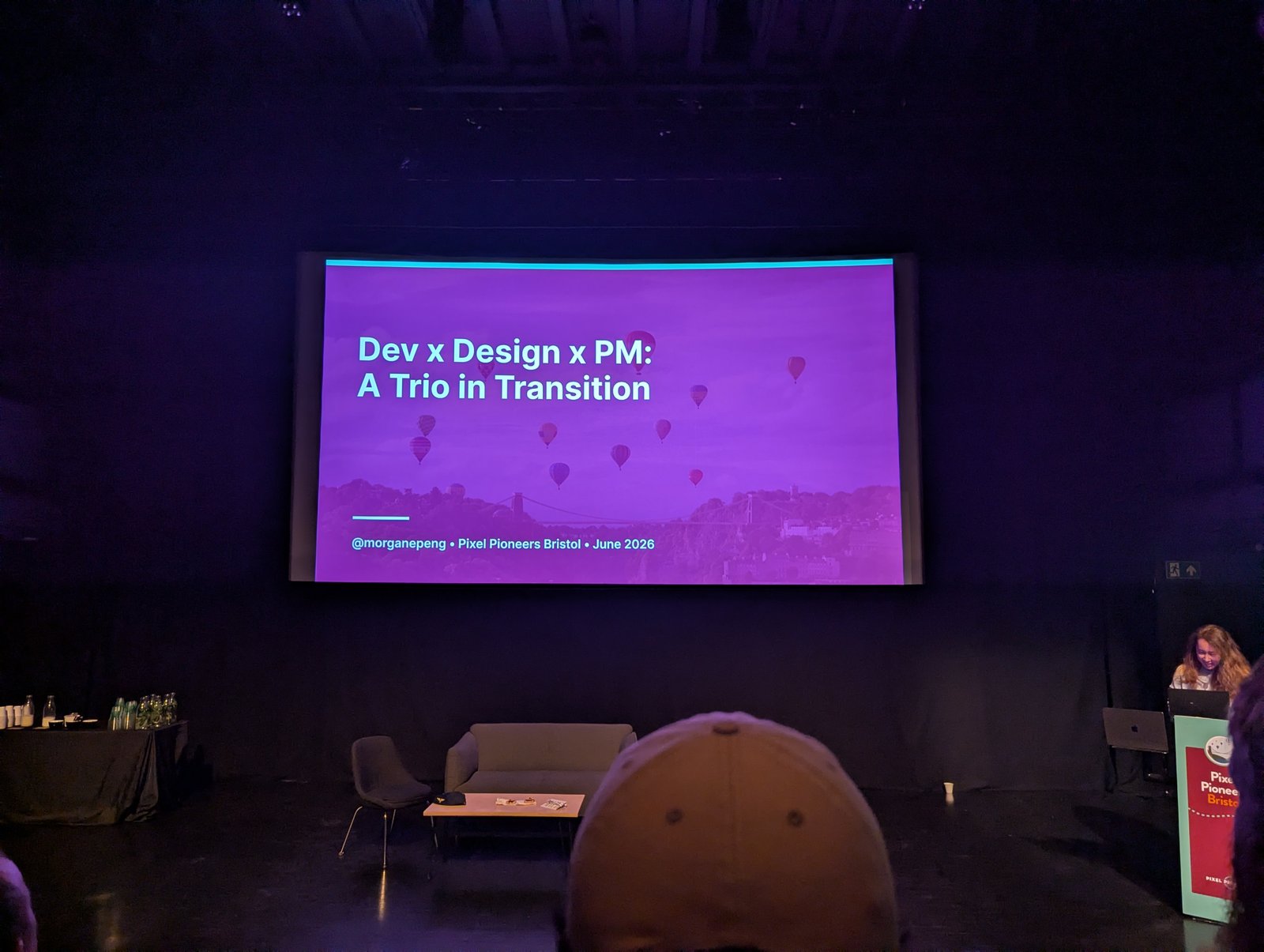
This was one of the talks closest to my heart and which related most to my experience. As someone who's worked in digital agencies for my entire career up to now, the communication between Dev, Design and PM has been something that I've seen in multiple different ways, and have iterated on multiple times myself.
Sometimes, I've felt as though perhaps I've been naive or even unreasonable in advocating for wider knowledge as to how another team works, and wanting to learn the same. In her talk, Morgane highlighted how it's very easy, and surprisingly common, for us to get quite Silo'd in our work, to be peripherally aware that what we're doing is part of working towards a common goal, but at the same time viewing the roles we play in getting there as entirely separate and nigh unrelated.
I think this was one of the first talks I've seen at a conference like this that I would be confident showing to a PM or Designer in whatever company I was working at with full confidence that it would benefit them to watch it!
Designing and Building for the Low-Carbon Web - By Nick Lewis
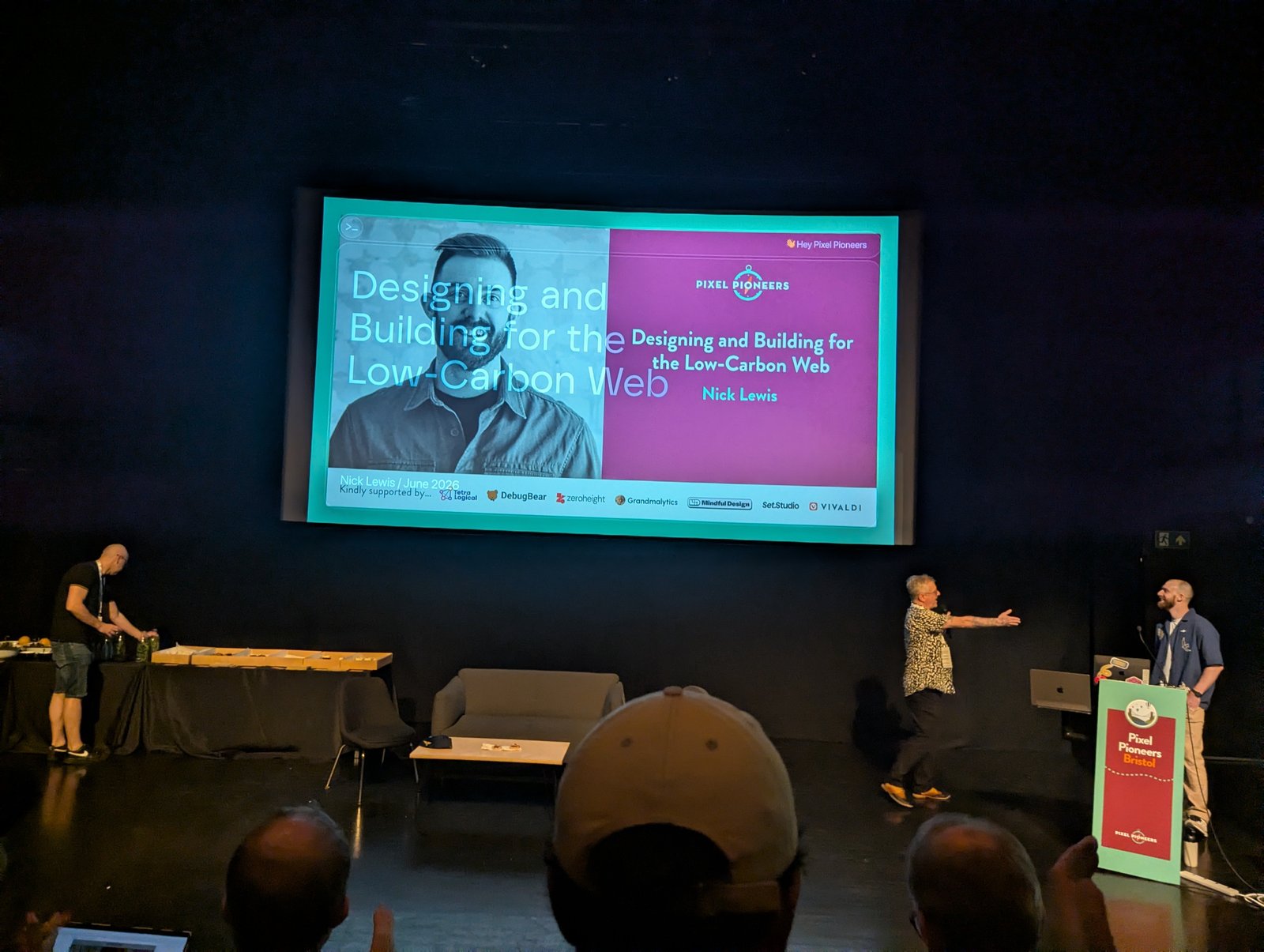
Near the end of my time at Studio24 one of the people hired on to the team was fellow ADHDer and Sustainability Expert Chris Butterworth - watching this talk made me think of him, as Nick seemed to have the same enthusiasm and gusto for the topic as Chris did.
Easily one of my favourite talks of the conference, Nick spoke about the potentially unseen ways a website can produce more carbon than one would initially think, and blew our collective minds with the sheer numbers of the carbon impact our industry can have, even before the emergence of AI.
He then suggested a number of things one could do to reduce their carbon footprint when building a website, that seem to align fairly well with the process of speed-optimising a site such as:
- Optimizing image sizes and serving them locally, to avoid the amount of memory they take up on a server or a user's machine
- Cleaning up unnecessary JavaScript files and node packages (This is an easy one to miss, and can take up whole lot of space, greatly increasing the amount of energy used by the website)
As well as some tips that one may not have initially thought of such as:
- The amount of energy your monitor is using up (You don't need an 8K monitor!)
- Serving things locally in general - rather than relying on requests to the cloud, or rather big cloud servers that serve millions of customers using the same machines, taking up an unnecessary amount of energy.
- Consider reducing the amount of JavaScript you use on your website, as new features of CSS and HTML mean things that we're used to relying on JavaScript for can be achieved without JavaScript. It doesn't mean you can't use JavaScript on your website, it just means use less.
- Thinking out your prompt to an AI agent before you send it, rather than using multiple prompts to get the information you want from the AI and using more tokens than necessary in the process.
As someone who cares a lot about the environment and doing my bit to reduce my own carbon footprint, this talk was particularly inspiring and will inform my work from here on.
Well, I didn't see that coming! - By Kardo Ayoub
In the much-contested pre-lunch slot was my personal favourite talk of the conference from the brilliant Kardo Ayoub. Over the course of my career, but specifically the last 3 years, accessibility has been something that I've focussed on and become a stark advocate of. Kardo's tale was as gripping as it was informative, as he told the story of how he lost the ability to see half of what was in front of him. There are two highlights from the talk I found particularly interesting:
- Kardo's eyes themselves are perfectly fine - it's the signals that get sent to his brain that are the source of his problem, in that the part of the brain that interprets the vision of the left eye has essentially short-circuited and shows nothing! It was super interesting to learn this particular nugget of brain-knowledge, and even moreso for the way in which it was presented.
- Over the last couple of years, accessibility has become something of a buzzword that companies are trying to capitalize on without entirely understanding what it is they're claiming to be representing. There was an example in which the same image of a person in a wheelchair using a computer was used in myriad articles concerning accessibility, painting it as one thing, one problem, with one solution - whereas the reality is there's a wide variety of different disabilities that can be accounted for, but are often not.
The latter part of the talk was particularly interesting for me. As of the time of writing, I've been on the hunt for a new role, and a consistent pattern I've noticed has been people saying that accessibility is important to them, and high on their list, and indeed a large gap in their company knowledge, but in the end, my focus on accessibility has somewhat worked against me.
I think the things I've learned from this talk have somewhat reassured me as to the importance of digital accessibility, and have given me more of a direction as to how to approach it when discussing it with companies.
Design Systems are Dead. Long live Design Systems - By Luke Murphy
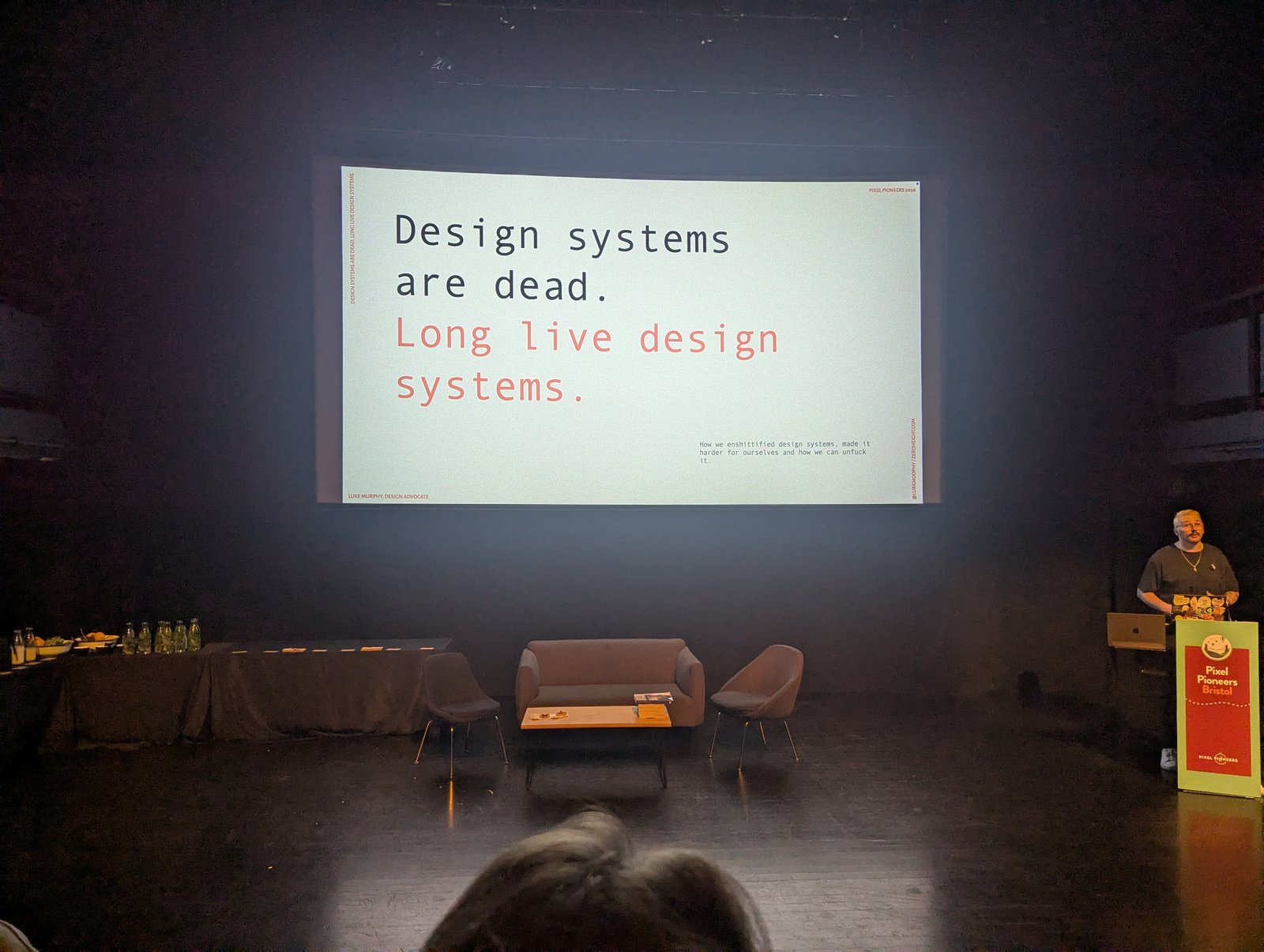
Following the absolute revelation that was my first ever falafel during the lunch break with Duncan and Ellie, with a rested mind and a full belly, we were treated to a great talk by Luke Murphy of Zeroheight.
Luke posed the idea that we've turned Design Systems into a commodity. In a similar way that "AI" was used as a buzzword in its infancy (where we still are), so too did Design Systems get bundled into things that weren't necessarily the definition of Design Systems.
The issue with this, is that it makes the whole idea of "Design Systems" quite foggy to someone who wouldn't necessarily be in the know. When a term is used too broadly to describe something, it inevitably gets applied to things that don't fit the term at all, and it seems this is where we've landed with the concept of design systems.
The idea is that we need to focus on simplifying and distilling the way we talk about design systems so that it's more clear what they're trying to achieve and why it's good to use them.
This idea of simplifying and demystifying things that we work with is something that I relate to greatly and is something I work to cultivate when I build things for people, so this talk was very validating for me.
The Latter Half
I could keep going forever about the individual talks at the conference, and I may even do that at a later date when the sun isn't melting my brain, but here's a brief overview of the rest of the talks from the conference, mostly in the form of what I thought of them:
Understanding Layout Between UI Design and Code - By Christine Vallaure
Christine gave an overview of commonly used CSS layouts and how they could be understood by and explained to a design team. This kind of information is invaluable when working on a team with people of varying disciplines and linked in well with Morgane's talk earlier in the day.
Language: The Secret Sauce of Great UX - By Candi Williams
I was really looking forward to this talk, as a bit of a word nerd myself, I can happily report that it did not disappoint! Candi took us through the importance of effective language and wording as it relates to UX and carried on the theme of "Let's make things as intuitive and easy to grasp as possible" that emerged in the latter half of the conference.
Making HTML Make Music - By Heydon Pickering
The last talk of the conference was a doozy! After the technical difficulties were dealth with (which were equally as enjoyable as the talk itself - that is to say very enjoyable!), Heydon took us through the absolute wizardry that he performed to create custom tags and functions in HTML to generate music! I would be lying if I said I understood all of it, but what I did understand was that this was incredible, and was an amazing showcase of the things that can be built with a simple idea, and expertise bordering on sagedom.
</PixelPioneers>
I believe I may have said this last year, but this Pixel Pioneers has been my favourite that I've been to so far. Not just because of the banquet of brain food I enjoyed from the many incredible talks at the event itself, but also because of the people I met there and the opportunity to just spend time with people who were just as passionate about what we all do as eachother.
Roll on next year!